
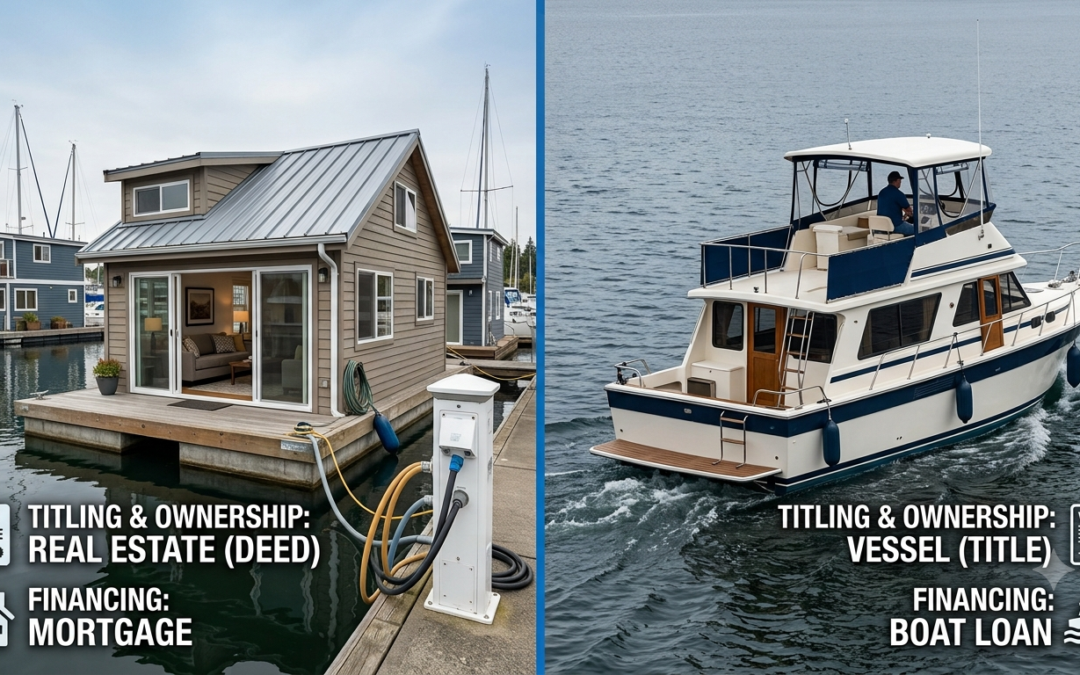
If you’ve been browsing listings on the Sausalito waterfront and noticed that some properties are called floating homes while others are called houseboats, you might assume it’s just a matter of marketing language. It’s not. The distinction between a floating home and a houseboat is a legal and financial one that affects how the property is titled, how it’s financed, how it’s taxed, and what kind of escrow process is required to close the deal. Getting clear on the difference before you make an offer is the kind of thing that saves buyers a significant amount of confusion later.
What Is a Floating Home?
A floating home is a residential structure built on a float or barge, permanently moored in a marina slip, and connected to utilities the same way a land-based home would be. It has a foundation, in a sense (the float it sits on) and it doesn’t move under its own power. In California, a floating home is classified as personal property under the Department of Housing and Community Development, the HCD, which titles it similarly to how the DMV titles a vehicle.
That personal property classification is what shapes everything else about a floating home transaction. There’s no grant deed, no county recorder filing, and no deed of trust if a lender is involved. Instead, the buyer receives an HCD certificate of title, and any lender’s interest is secured through a security agreement rather than a traditional mortgage instrument.
The approximately 425 floating homes spread across Sausalito’s five marinas represent one of the most concentrated floating home markets in the state. Most of the buyers and agents who work in this market are familiar with the classification, but buyers coming from a traditional real estate background are often surprised by how different the paperwork looks.
What Is a Houseboat?
A houseboat is a vessel. It has a motor, or at minimum the capacity to move under its own power, and it’s registered with the California Department of Motor Vehicles or the U.S. Coast Guard as a boat, not titled through HCD as a residence. Some houseboats are used as full-time residences, but they’re legally a watercraft first.
That distinction matters enormously for financing, insurance, and the closing process. Lenders who will finance a floating home as personal property may not finance a houseboat at all, or may require marine financing rather than a residential loan. Insurance is handled through marine policies rather than homeowner’s policies. And when it comes time to transfer ownership, you’re dealing with a vessel title transfer, not an HCD title transfer.
The lifestyle can look similar from the outside. Both float, both have kitchens and bedrooms, and both come with a view that’s hard to argue with. But from a legal and transactional standpoint, they’re completely different categories of property.
How Floating Home Escrow Works
Because a floating home is personal property, floating home escrow operates under a framework that most standard escrow companies have never encountered. The escrow officer has to coordinate the HCD title transfer, manage the berth lease assignment with the marina, arrange a security agreement if a lender is involved, and confirm that personal property taxes are current before the file closes.
None of those steps exist in a typical residential real estate transaction. A buyer purchasing a floating home in Sausalito or Marin is essentially navigating a hybrid closing process that borrows elements from real estate, personal property law, and landlord-tenant law all at once. The berth lease, in particular, catches a lot of buyers off guard. The home may sell, but the slip it sits in belongs to the marina, and the new owner has to be approved as a tenant before the transaction is complete.
We handle these files regularly, and the difference between working with an experienced escrow officer and one who’s figuring it out as they go shows up clearly in the timeline and the stress level of everyone involved.
How Houseboat Ownership Transfers
Transferring ownership of a houseboat is closer to selling a car or a boat than selling a home. The seller signs over the vessel title, the buyer registers the vessel in their name, and any lender files a lien against the vessel through the appropriate registry. There’s no HCD involvement, no berth lease to assign (though a slip agreement may transfer separately), and no deed or security agreement in the real estate sense.
If a houseboat is permanently moored and used as a primary residence, some of the practical closing steps overlap with what you’d see in a floating home sale, particularly around the slip agreement and utility connections. But the legal classification stays the same: it’s a vessel, and it transfers like one.
Taxes: Personal Property vs. Vessel Registration
Floating homes in Marin County are assessed for personal property tax, which is calculated and billed similarly to business personal property. The tax follows the property, not the owner, so buyers should always request a tax clearance through escrow to confirm there are no unpaid taxes that would transfer with the title.
Houseboats, registered as vessels, are subject to vessel registration fees through the DMV rather than local personal property tax assessment. Some counties do assess in-lieu fees or local taxes on live-aboard vessels, but the mechanism is different and the amounts are typically lower.
Your escrow officer can walk you through the tax picture for the specific property you’re considering. The details vary by county and by how the property has been historically classified, so confirming early in the process avoids surprises at closing.
Financing Differences
Getting a loan for a floating home is possible, but the pool of lenders is smaller than what you’d find for a traditional home purchase. Lenders who work in this space understand the HCD title and security agreement structure, and they’re accustomed to underwriting a property that doesn’t sit on land. Interest rates and down payment requirements tend to be higher than a comparable residential purchase, and some lenders require the home to have been moored in its current slip for a minimum period.
For a houseboat, financing typically runs through marine lenders or personal property lenders rather than residential mortgage companies. The terms are generally shorter and the rates are higher, and not every lender will finance a vessel being used as a primary residence.
Buyers exploring either category should get lender conversations started early. The financing approval timeline can affect how the escrow is structured, and knowing your loan options before you’re under contract makes the whole process cleaner. We work alongside real estate escrow and personal property transactions alike, and we can help coordinate the escrow structure once your financing picture is clear.
Which One Are You Looking At?
The most practical way to know what you’re dealing with is to look at how the property is currently titled. If it has an HCD certificate of title, it’s a floating home. If it has a DMV or Coast Guard vessel registration, it’s a houseboat. Your agent should be able to confirm this before you make an offer, and if they can’t, your escrow officer can pull the title information early in the process.
For buyers coming from a traditional real estate background, both categories require some adjustment in expectations. The manufactured home escrow process shares some similarities with floating home transactions, particularly around HCD titling, so if you’re exploring multiple waterfront or non-traditional property types it’s worth understanding how each one is handled.
FAQs
Is a floating home considered real property in California?
No. Floating homes in California are classified as personal property and titled through the HCD, not through the county recorder’s office. This affects how they’re financed, insured, and transferred.
Can I get a traditional mortgage for a floating home?
Traditional residential mortgages don’t apply to floating homes because there’s no real property deed to secure the loan against. Lenders who finance floating homes use a security agreement tied to the HCD title instead. The pool of willing lenders is smaller, and terms are typically different from a conventional mortgage.
What is a berth lease and why does it matter in a floating home sale?
A berth lease is the agreement between the homeowner and the marina that governs the slip where the home is moored. When a floating home sells, the berth lease must be assigned to the new owner, and the marina has to approve the buyer as a new tenant. This step can add time to the closing process if it’s not started early.
Do floating homes appreciate in value the same way land-based homes do?
Floating home values are influenced by the same broad market forces as land-based real estate, but they can also be affected by marina lease terms, slip availability, and the overall condition of the float. The Sausalito market has seen strong appreciation over time, but each property should be evaluated individually.
What happens if personal property taxes are unpaid when a floating home sells?
Unpaid personal property taxes follow the property to the new owner. Buyers who don’t request a tax clearance through escrow risk inheriting that liability. We pull this clearance as a standard step in every floating home file we handle.
How is a houseboat sale different from a floating home sale at closing?
A houseboat transfers as a vessel title, not an HCD title. The closing process is closer to a vehicle or boat sale than a real estate transaction, and the escrow structure, if escrow is used at all, reflects that. Floating home sales are more structured and typically require a dedicated escrow officer familiar with HCD transfers.
Talk to an Escrow Team That Knows the Water
Floating home transactions are genuinely different from anything else in the Bay Area real estate market, and the details matter. Whether you’re a buyer trying to understand what you’re getting into or an agent looking for a reliable escrow partner on a Sausalito file, we’re here to help. Call us at (925) 831-9099 or reach out to our team and let’s talk through your transaction.