
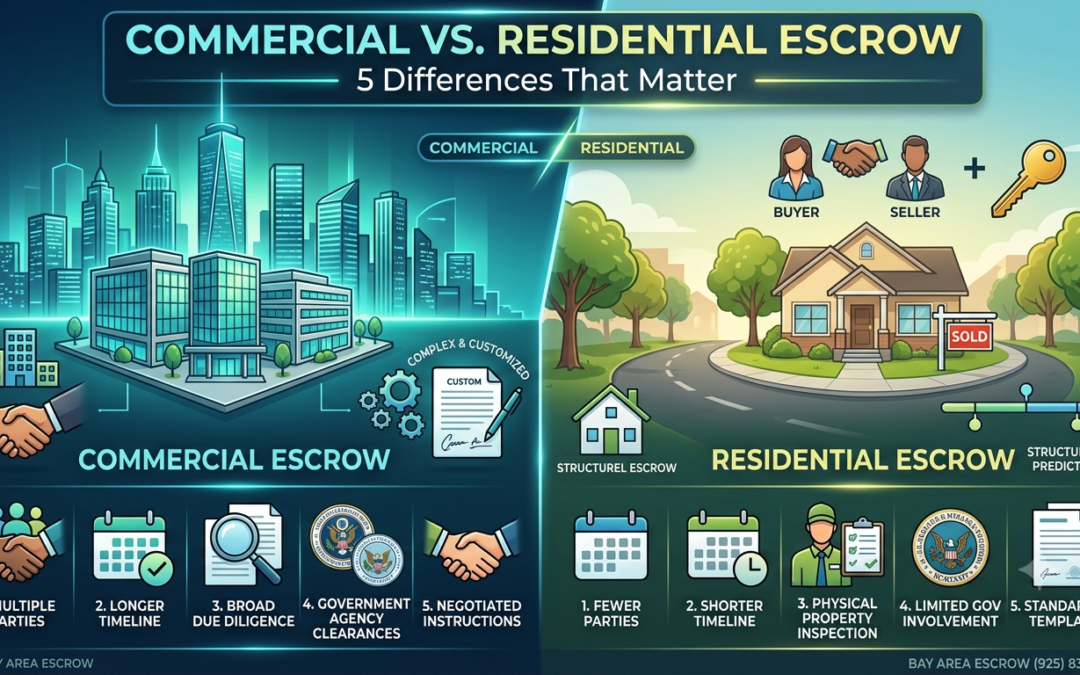
Most people’s first experience with escrow is a home purchase. The process is structured, the timeline is predictable, and the cast of characters is relatively small. When those same people turn around and buy or sell a commercial property or a business, they often assume the escrow process works the same way with a few extra steps. It doesn’t. Commercial vs. residential escrow differences go well beyond paperwork volume, and understanding them before you start a transaction saves a lot of confusion once the file is open. Here are the five differences that actually matter.
-
Complexity and Number of Parties Involved
A residential escrow typically involves a buyer, a seller, a lender, and a title company. Everyone has a defined role, the process follows a familiar template, and most of the coordination happens between the escrow officer and the lender. It’s structured precisely because the vast majority of home purchases follow the same basic pattern.
Commercial escrow is a different animal. A commercial real estate transaction or business sale can involve multiple lenders, business brokers, commercial agents, attorneys, landlords, government agencies, and in some cases licensing boards, all with competing priorities and independent timelines. A business sale in Oakland or San Ramon that involves a liquor license, a commercial lease assignment, and a bulk asset transfer has four or five parallel tracks running simultaneously, and the escrow officer is managing all of them at once.
Our commercial escrow services are built around exactly that level of coordination. A residential escrow template doesn’t scale to a commercial file; the work is fundamentally different.
-
Timeline
A residential escrow in California typically closes in 30 to 45 days. Lenders drive most of that timeline, and experienced teams have refined the process to move efficiently within that window. Buyers and sellers generally know what to expect and when.
Commercial escrow timelines are longer and considerably less predictable. A straightforward commercial property purchase might close in 45 to 60 days, but a business sale involving government clearances from the CDTFA, EDD, FTB, and county tax collector, combined with a bulk sale notice period and an ABC license transfer, can run 60 to 90 days or more. Each agency moves on its own schedule, and no amount of urgency from the buyer or seller speeds up a state clearance process that has its own queue.
The practical implication for buyers and sellers in Danville, Walnut Creek, or San Francisco is that commercial transactions require more runway in the planning process. Setting a close date without accounting for realistic government processing times is one of the more common mistakes we see in commercial files handled by teams without deep experience in this space. A thorough look at how these timelines interact is also covered in our guide to common escrow mistakes to avoid.
-
Due Diligence Scope
In a residential escrow, due diligence is primarily physical. The buyer hires an inspector, reviews the disclosure packet, and satisfies themselves that the property is in acceptable condition. The financial review is limited to confirming the purchase price and the loan terms.
Commercial due diligence is an entirely different exercise. A buyer purchasing a commercial property or business is reviewing financial statements, tax returns, lease agreements, environmental reports, zoning compliance, existing contracts, employee obligations, pending litigation, and license histories. Each of those categories can surface issues that affect the purchase price, the transaction structure, or the buyer’s decision to proceed at all.
For business transfer escrow transactions specifically, the due diligence period is often the longest phase of the process and the one where deals are most likely to be renegotiated or terminated. An experienced escrow officer doesn’t conduct due diligence for the buyer, but they track contingency removal carefully and make sure the file doesn’t advance to close until the buyer has formally satisfied every condition in writing.
-
Government Agency Involvement
This is the difference that catches residential buyers most off guard when they make their first commercial purchase. A standard home sale has essentially no government agency involvement in the escrow process beyond the county recorder’s office recording the deed. The title company handles the recording, the lender funds the loan, and the transaction closes.
A commercial or business escrow in California routinely involves multiple state agencies that have to be notified and, in most cases, have to issue clearances before escrow can close. The CDTFA reviews the seller’s sales tax account. The EDD confirms payroll tax obligations. The FTB reviews state income tax status. The county tax collector confirms business personal property taxes are current. If a liquor license is involved, the ABC runs its own independent investigation and approval process.
None of these agencies communicate with each other, and none of them coordinate their timelines with the escrow close date. The escrow officer tracks every open clearance, follows up with each agency, and flags delays early enough that the parties can make informed decisions about extending the close date or structuring a holdback. For transactions involving a bulk asset transfer, the bulk sales and ABC license transfer escrow process adds its own layer of required notice and documentation on top of the agency clearances.
-
Escrow Instructions and Customization
Residential escrow instructions follow a largely standardized format. The terms are familiar, the contingencies are predictable, and most residential escrow officers work from templates that cover the vast majority of transactions they’ll ever see.
Commercial escrow instructions are negotiated and customized for every transaction. The parties determine their own contingency periods, their own conditions for deposit release, their own holdback structures, and their own cancellation terms. A commercial escrow instruction set for a restaurant sale in San Francisco looks nothing like one for a commercial property acquisition in Brentwood, even if the dollar amounts are similar.
This customization is a feature, not a bug. Commercial transactions are more varied and more complex than residential ones, and cookie-cutter instructions don’t protect either party adequately. But it does mean that commercial escrow instructions require more care, more negotiation time, and more attention from both parties and their attorneys before they’re signed. The escrow disbursement process at the end of a commercial transaction is also more involved, with more parties receiving funds and more line items to reconcile on the final closing statement.
A holding escrow arrangement, which is rarely needed in residential transactions, comes up regularly in commercial files where one condition is still pending at the time of close and both parties agree to structure a holdback rather than extend the entire transaction.
FAQs
Can the same escrow officer handle both residential and commercial transactions?
Technically yes, but the skill sets required are quite different. An escrow officer who primarily handles residential files may be unfamiliar with bulk sale requirements, government agency clearances, ABC license transfers, or the customized instruction structure that commercial transactions require. For a commercial or business sale, working with an escrow company that handles these files regularly is worth the extra step of finding the right provider.
Is title insurance handled the same way in commercial escrow?
Title insurance exists in both residential and commercial transactions, but commercial title policies are more complex and often require more negotiation around the coverage terms and any exceptions. Commercial buyers should review the title commitment carefully with their attorney rather than assuming the coverage mirrors what they’ve seen in a residential transaction.
Why do commercial escrows cost more than residential ones?
Commercial escrow fees reflect the additional work involved: more parties to coordinate, more documents to prepare and track, government agency filings, bulk sale notice publication, and longer timelines. Fees are typically negotiated as part of the purchase agreement and allocated between buyer and seller. Your escrow officer will provide a fee disclosure when the file opens.
What happens if one government clearance is delayed but everything else is ready to close?
The parties have a few options: extend the close date to wait for the clearance, structure a holdback arrangement where funds are retained in escrow pending resolution, or in some cases close with a conditional clearance. Your escrow officer can walk you through the options specific to your transaction, and your attorney can advise on any legal implications of proceeding before all clearances are final.
Does commercial escrow require an attorney?
Escrow officers are neutral parties who manage the process and follow written instructions; they don’t provide legal advice. For any commercial transaction, having an attorney review the purchase agreement, the escrow instructions, and the lease terms is a sound practice. The complexity of commercial transactions creates legal exposure that an attorney is better positioned to address than an escrow officer.
Is a commercial escrow more likely to fall through than a residential one?
Commercial transactions have more conditions, more parties, and more variables than residential ones, which statistically creates more opportunities for something to go sideways. A well-prepared buyer, a thorough purchase agreement, and an experienced escrow team significantly reduce that risk, but commercial deals do require more active management throughout the process to keep all tracks moving toward a successful close.
One Team for Every Type of Escrow
Whether your next transaction is a commercial property acquisition, a business purchase, or something more complex that doesn’t fit a standard template, Bay Area Escrow has the experience to manage it from open to close. We work with buyers, sellers, and brokers across the Bay Area every day, from Oakland to San Francisco to Walnut Creek and beyond. Call us at (925) 831-9099 or contact our escrow team to talk through your transaction and get your file started.