
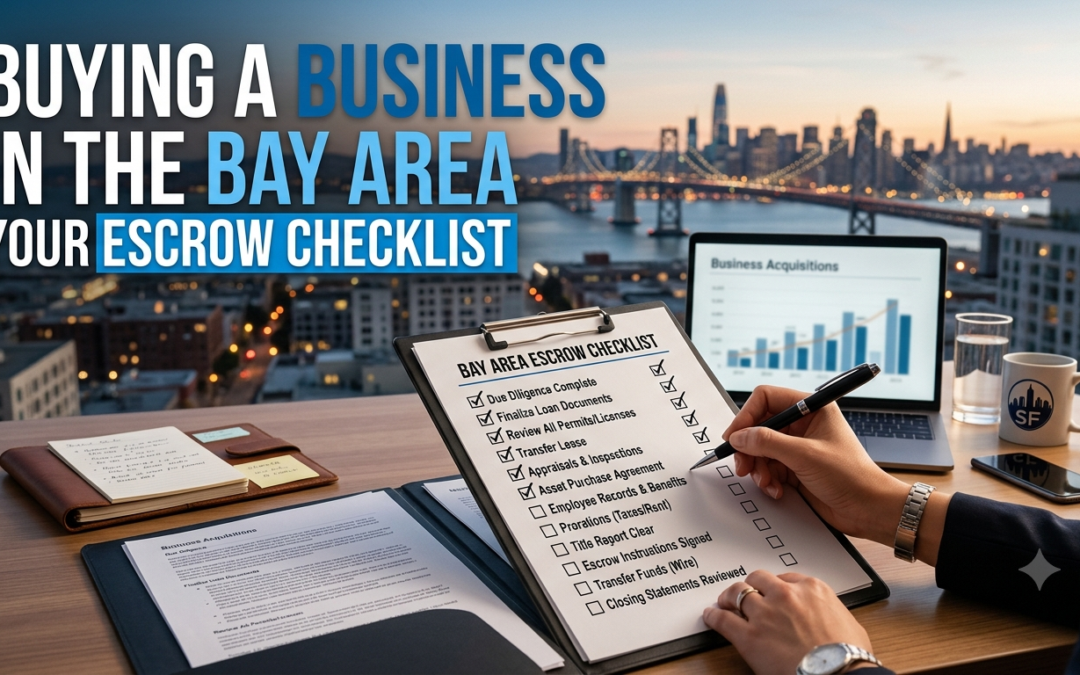
Buying a business in the Bay Area is not a small undertaking. Between the purchase price, the lease, the licenses, the government clearances, and the escrow process, there are more moving parts than most buyers anticipate when they first make an offer. The good news is that when you know what’s coming, you can plan for it. This checklist walks through every major step of the escrow process for a Bay Area business purchase so nothing catches you off guard between the day you sign the purchase agreement and the day you get the keys.
Before Escrow Opens: What to Have Ready
The work that happens before escrow opens shapes how smoothly everything else runs. Buyers who walk into a transaction organized and prepared close faster and with fewer surprises than those who start gathering documents after the clock is already ticking.
Before your escrow file opens, you should have a fully executed purchase agreement that clearly defines the purchase price, what’s included in the sale, the proposed close date, and any contingencies. You should also have your financing confirmed or a clear plan for how the purchase will be funded. Lenders who are familiar with business acquisitions will move more efficiently than those who aren’t, and in the Bay Area, where business sale prices in markets like San Francisco, Oakland, and Walnut Creek can be substantial, getting lender commitment early matters.
If the business has an ABC liquor license, start thinking about the transfer application immediately. The ABC process is the longest single track in most restaurant or bar purchases, and every day you delay the application is a day added to the back end of your timeline.
Opening Escrow: The First Week
When the purchase agreement is delivered to escrow along with your initial deposit, the clock starts. The escrow officer prepares the escrow instructions, which both parties sign to establish the rules and conditions governing the transaction. Read those instructions carefully before you sign them. Vague or incomplete instructions are one of the most common sources of disputes later in the process.
In the first week, your escrow officer should also be:
- Identifying all government agencies that need to be notified or will need to issue clearances
- Initiating the bulk sale notice process if your transaction involves inventory or business assets
- Contacting the landlord about lease assignment if the business operates from a leased location
- Opening the ABC license transfer application process if a liquor license is involved
The business transfer escrow process is most efficient when all of these tracks start simultaneously rather than sequentially. Waiting until one step is complete before starting the next one is the most reliable way to push your close date back by weeks.
The Due Diligence Checklist
Due diligence is your opportunity to verify everything the seller has represented about the business before you remove your contingencies and commit to closing. A thorough due diligence process for a Bay Area business purchase typically covers:
- Financial records: Two to three years of tax returns, profit and loss statements, and sales records; confirm the revenue numbers match what was represented in the purchase agreement
- Lease review: Confirm the lease terms, the remaining lease period, any personal guarantee requirements, and the landlord’s conditions for assigning the lease to you
- Inventory count: If the purchase price includes inventory, a physical count near the close date is standard; prices are often adjusted based on the final count
- Equipment and assets: Confirm the condition of all equipment included in the sale and check for any liens or encumbrances filed against business property
- Licenses and permits: Beyond the ABC license if applicable, confirm all city and county business licenses, health permits, and any industry-specific permits are current and transferable
- Employee matters: Review any employment agreements, union contracts, or obligations that will carry over to you as the new owner
- Pending litigation: Ask directly and confirm through your attorney whether any claims, disputes, or lawsuits are pending against the business
Your escrow officer doesn’t conduct due diligence for you, but they track the contingency removal process and make sure the file doesn’t proceed to close until you’ve formally signed off in writing. If something surfaces during due diligence that changes your view of the deal, that’s the time to negotiate an amendment or exit the transaction cleanly.
Government Clearances: What to Expect
This is the part of buying a business in the Bay Area that surprises most first-time buyers, especially those coming from a real estate background. A business sale in California requires clearances from multiple state and local agencies before escrow can close, and those agencies move on their own schedules.
The clearances typically required include:
- CDTFA (California Department of Tax and Fee Administration): Confirms the seller has no unpaid sales tax obligations that could transfer to the buyer
- EDD (Employment Development Department): Confirms payroll taxes and unemployment insurance accounts are clear
- FTB (Franchise Tax Board): Confirms state income tax obligations are resolved
- County Tax Collector: Confirms business personal property taxes are current
Each agency has its own form, its own processing timeline, and its own definition of “clear.” Some respond within a few weeks; others take longer, particularly if the seller’s account has any flags or open balances. We track every outstanding clearance on every commercial escrow services file we manage and follow up proactively so delays surface early rather than in the final week before the target close date.
The Bulk Sale Notice
If your transaction involves a substantial transfer of business inventory, supplies, or equipment, California law generally requires a bulk sale notice to be published in a local newspaper of general circulation at least 12 business days before escrow closes. The notice alerts the seller’s creditors that the sale is coming and gives them a window to come forward with any valid claims.
For buyers, this step is a protection. A properly completed bulk sale process limits your exposure to the seller’s pre-existing creditor obligations. Skipping it or doing it incorrectly can leave you liable for debts you didn’t know about long after the transaction closes. We handle the publication and CDTFA notification as part of our bulk sales and ABC license transfer escrow process, and we time the notice to run concurrently with due diligence rather than after it.
Lease Assignment
If the business you’re purchasing operates from a leased space, the landlord has to agree to assign the lease to you before you can take over the business. This is not automatic and it’s not guaranteed. Landlords have the right to evaluate the incoming tenant, and some require financial statements, personal guarantees, or updated lease terms as a condition of approval.
The lease assignment process should start early in the escrow period, ideally in the first two weeks. A landlord who takes a month to respond to an assignment request can hold up an entire transaction that is otherwise ready to close. Buyers should also review the lease terms carefully during due diligence, because taking over a lease with unfavorable terms or a short remaining term is a business risk that needs to be understood before the deal is done.
Funds, Prorations, and the Closing Statement
As the close date approaches, the escrow officer prepares the final closing statement, which itemizes every dollar flowing through escrow. This includes the purchase price, the buyer’s deposit already on account, any inventory adjustments based on the final count, prorations for rent and prepaid expenses, escrow fees, and all disbursements going out to the seller and any third parties.
Review this statement line by line. Errors in proration calculations or incorrect payoff figures are far easier to fix before funds are disbursed than after. The escrow disbursement process moves quickly once the final statement is approved by both parties, so taking the time to review it carefully is time well spent.
Wire instructions should always be verified by phone with your escrow officer directly, using a number you already have on file. Wire fraud targeting business transactions is a known and growing problem in California, and confirming instructions verbally before sending any funds is a non-negotiable step.
A Note on Using a Holding Escrow
Some business purchases involve a period between signing and close where funds need to be secured but the transaction isn’t quite ready to finalize. A holding escrow arrangement can bridge that gap, holding funds securely while a specific condition, such as a pending ABC approval or a landlord’s delayed response, gets resolved. This is a structured option, not an informal one, and it needs to be documented in the escrow instructions. Your escrow officer can walk you through when it makes sense for your transaction.
Your Business Purchase Escrow Checklist at a Glance
- Execute a complete, detailed purchase agreement before opening escrow
- Confirm financing or funding before the file opens
- Sign escrow instructions promptly and review them carefully
- Submit ABC license transfer application in week one if applicable
- Begin due diligence immediately: financials, lease, inventory, permits, employee obligations
- Initiate bulk sale notice process in the first week
- Contact the landlord for lease assignment approval early in the process
- Track CDTFA, EDD, FTB, and county tax clearances throughout
- Review the final closing statement line by line before approving disbursement
- Verify all wire instructions by phone before sending any funds
FAQs
How long does a business purchase escrow take to close in the Bay Area?
Most business escrow transactions in the Bay Area close in 45 to 75 days. Transactions involving an ABC license transfer often take 60 to 90 days or more. The timeline depends heavily on how quickly government clearances come back and whether any complications arise during due diligence or the lease assignment process.
Do I need an attorney when buying a business through escrow?
Escrow officers are neutral parties who manage the process; they don’t provide legal advice. For a transaction involving a business purchase, an employment contracts review, a lease negotiation, or any complex contingency, working with a business attorney alongside your escrow company is a sound approach. Your specific situation may have legal dimensions that go beyond what escrow manages.
What happens to my deposit if the deal falls through during due diligence?
The deposit is held in escrow and released according to the cancellation terms agreed to in the escrow instructions. If you exit the transaction within your due diligence period and have properly removed no contingencies, your deposit is typically returnable. Once contingencies are removed, the terms governing deposit release change. Your escrow officer and attorney can walk you through the specific terms for your transaction.
Can I negotiate the terms of a lease assignment with the landlord?
Yes. A lease assignment is a negotiation between you and the landlord, and some buyers use the assignment process as an opportunity to negotiate updated lease terms, particularly if the existing lease is near expiration. What you can negotiate depends on the existing lease language and the landlord’s position.
Is a bulk sale notice always required when buying a Bay Area business?
Not every transaction triggers the requirement, but any sale involving a substantial transfer of inventory, supplies, or equipment outside the normal course of business generally does. California Commercial Code governs the specifics. Your escrow officer can confirm whether your transaction requires a bulk sale notice based on the assets included in the sale.
What if a government clearance is delayed and holds up the close?
Clearance delays are common and most transactions work through them. Options include extending the close date by mutual agreement, structuring a holdback arrangement for specific unresolved items, or in some cases closing with a conditional clearance. Your escrow officer will flag the delay as soon as it’s identified and work with both parties on the best path forward.
Ready to Get Your Business Purchase Moving?
Buying a business in the Bay Area has a lot of steps, but every one of them is manageable when you’re working with an escrow team that has done this before. We handle business transfers across the Bay Area every day, from San Ramon and Danville to Oakland and San Francisco, and we know what it takes to get a file to close on time and on terms. Call us at (925) 831-9099 or contact our escrow team to open your file and get started.