
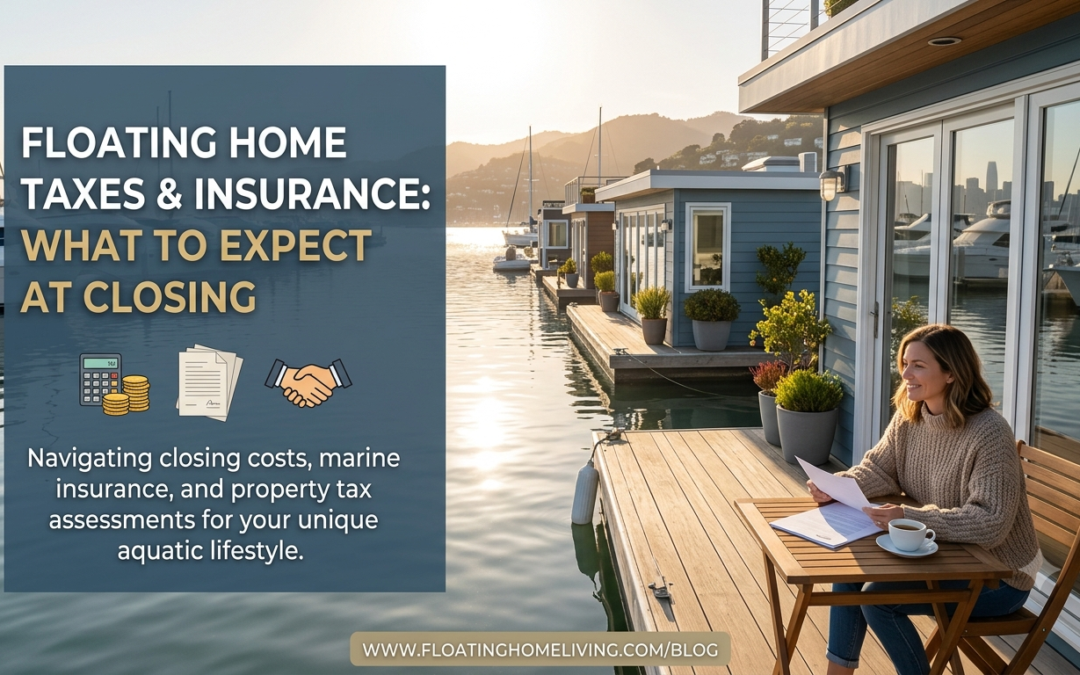
One of the bigger surprises for buyers new to the floating home market is discovering that floating home taxes and insurance don’t work anything like what they’ve dealt with before. There’s no property tax bill that looks like the one they get for a land-based home, no standard homeowner’s policy from their usual insurer, and a handful of closing-specific requirements that most escrow companies have never had to manage. If you’re buying or selling a floating home in Sausalito, Marin, or anywhere else in the Bay Area, understanding the tax and insurance picture before you get to closing saves a lot of last-minute scrambling.
How Floating Home Taxes Work in California
California is one of the few states where floating homes occupy a genuinely unusual position in the tax code. Under Revenue and Taxation Code Section 229, floating homes are treated as real property for tax assessment purposes, meaning they are subject to Proposition 13 protections and assessed similarly to land-based homes. However, because the home itself is classified as personal property under HCD titling, the way the tax is administered and tracked doesn’t always follow the same path as a standard real estate transaction.
What this means practically is that the county assessor tracks the floating home separately from the berth it occupies. The home is assessed based on its value, and the tax bill goes to the registered owner on file with the county. When ownership changes, the assessor needs to be notified and the assessment may be recalculated based on the sale price, just as it would be for a residential property transfer.
Buyers should not assume the floating home taxes are current just because the seller says they are. Marin County’s records don’t always update instantly when a home changes hands, and a discrepancy between the HCD registered owner and the county’s assessment records can create confusion about who owes what. We pull a tax status confirmation as a standard step in every floating home escrow file we handle, because catching a tax issue in week one is considerably easier than resolving it in the final days before close.
The Tax Clearance Requirement
Before an HCD title transfer can be completed in California, a tax clearance certificate must be obtained from the county tax collector confirming that no taxes are outstanding on the floating home. This is not optional, and it’s not a formality. The HCD will not process the title transfer without it.
California Code of Regulations Title 25, Section 5547.1 requires the tax clearance certificate as part of the registration packet submitted to HCD when a floating home changes ownership. Getting the clearance involves the tax collector reviewing the property’s assessment history, confirming all taxes are paid through the current period, and issuing a certificate that the escrow officer includes with the title transfer paperwork.
In most cases, if taxes are current, the clearance comes back without issues. If there are unpaid taxes, a conditional tax clearance can sometimes be issued that allows the transfer to proceed while the outstanding balance is settled through escrow. Your escrow officer can walk you through how this is handled in your specific situation, but the key takeaway for buyers is that unpaid floating home taxes don’t stay with the seller, they follow the property, and confirming the tax status before close is how you protect yourself.
How Floating Home Taxes Are Prorated at Closing
Like any property sale in California, floating home taxes are prorated between buyer and seller based on the closing date. The escrow officer calculates the proration using the current tax bill and divides the annual tax obligation proportionally between the two parties for the portion of the year each owns the home.
Buyers should factor the ongoing tax obligation into their budget planning before they’re under contract. Floating home taxes in Marin County are assessed based on the home’s value, and for well-appointed homes in Sausalito’s more desirable marinas, the annual tax bill can be meaningful. The first tax bill after close will reflect the reassessed value based on the purchase price, so buyers who are purchasing at a significantly higher value than the previous sale should expect a higher assessment going forward.
The escrow disbursement process handles the proration calculation as part of the final settlement statement. Reviewing that statement line by line before authorizing disbursement is always worth the time.
Floating Home Insurance: Why It’s Different
Standard homeowner’s insurance policies are not written for floating homes, and buyers who call their existing insurer and ask to add a floating home to their policy will usually be told to look elsewhere. Floating homes require specialized insurance that accounts for the marine environment, the risk of flooding, the exposure to saltwater corrosion, and the unique hazards of living on the water.
Most floating home insurance policies combine elements of a homeowner’s policy and a marine policy into a single package. Coverage typically includes the structure itself, personal property inside the home, liability, and in some cases the float or barge the structure sits on. The float is a critical component — if it’s damaged or degraded, the entire home is at risk, and not all policies cover it as a standard inclusion. Buyers should ask explicitly about float coverage when getting insurance quotes.
Insurers who specialize in floating home coverage include companies with dedicated marine residential divisions, and some lenders who finance floating homes have preferred insurer relationships they can point buyers toward. Rates tend to be higher than comparable land-based homeowner’s insurance, and the gap widens for older homes or homes on floats that haven’t been recently inspected.
What Lenders Require for Insurance at Closing
If a buyer is financing a floating home purchase, their lender will require proof of insurance before the loan funds and escrow closes. The coverage requirements vary by lender, but most require a minimum dwelling coverage amount that covers at least the loan balance, liability coverage, and flood coverage if the marina’s location warrants it.
Buyers should start the insurance conversation early in the escrow process, not in the final week. Getting quotes from multiple insurers who write floating home policies takes time, and lender-required coverage minimums sometimes require a specific policy structure that not every insurer offers. Coming to the closing table without confirmed insurance in place is one of the more avoidable ways to delay a close.
The lender’s security agreement, which functions in place of a deed of trust for floating home financing, typically names the lender as an additional insured on the policy. This is standard for personal property financing and your insurer will be familiar with it, but the escrow officer coordinates with both the lender and the insurance provider to confirm all requirements are met before the close date is confirmed.
Moorage Fees and What They Have to Do With Closing
Moorage fees aren’t technically a tax, but they function like one for floating home owners and they show up in the closing process in a meaningful way. When the escrow officer calculates prorations for the closing statement, monthly moorage fees owed to the marina are prorated between buyer and seller just like taxes and other carrying costs.
More importantly, the marina will not process a berth lease assignment if the seller has an outstanding moorage balance. Unpaid moorage fees can hold up the lease transfer, and a delayed lease transfer holds up the entire closing. We request a current moorage ledger from the marina at the outset of every file so any balance issues are identified and resolved well before they become a closing problem.
For buyers comparing the cost structure of a floating home to a land-based property, the monthly cost picture includes the mortgage or loan payment, moorage fees, property taxes, insurance, and utilities. Of those, the moorage fee is the one most buyers underestimate until they see the actual lease terms. Fees in Sausalito’s marinas vary by slip size and location but can run well into the hundreds of dollars monthly, and they’re subject to adjustment by the marina over time.
For buyers considering other types of non-traditional property alongside floating homes, our manufactured home escrow resources cover similar territory around tax treatment and HCD titling for manufactured homes, which follow a comparable structure in several important ways.
FAQs
Are floating home taxes in California assessed the same way as regular property taxes?
California treats floating homes as real property for assessment purposes under Revenue and Taxation Code Section 229, so Proposition 13 protections apply and the tax is calculated based on assessed value. However, the administrative process differs from a standard real estate transaction because the home is titled through HCD rather than recorded at the county recorder’s office. Your escrow officer can walk you through how the assessment and clearance process works for the specific property you’re purchasing.
What happens if there are unpaid floating home taxes at the time of sale?
Unpaid taxes follow the property, not the seller. A buyer who closes without confirming the tax status could inherit an outstanding tax liability. The HCD title transfer process requires a tax clearance certificate, so unpaid taxes will surface before close, but knowing about them early gives everyone more time to resolve them cleanly through escrow.
Can I use my existing homeowner’s insurance for a floating home?
Standard homeowner’s policies don’t cover floating homes. You’ll need a specialized marine residential policy that accounts for the unique risks of living on the water. Most major insurers don’t write these policies directly; buyers typically work with specialty insurers or marine insurance brokers to find appropriate coverage.
Is flood insurance required for a floating home in Sausalito?
It depends on the lender and the specific marina’s flood zone designation. Some lenders require it, others treat the water location as already factored into the marine policy structure. Confirming your lender’s requirements early in the escrow process is the best way to avoid a last-minute coverage gap.
How are floating home taxes prorated at closing?
The escrow officer calculates the proration based on the current annual tax bill and divides it proportionally between buyer and seller based on the closing date. The buyer is responsible for their share of the year going forward, and the seller’s share through the close date is reflected in the final settlement statement.
Does the assessed value of a floating home reset when it sells?
Yes. California’s Proposition 13 framework applies to floating homes, which means a sale triggers a reassessment at the purchase price. Buyers purchasing at a higher value than the previous sale should expect their annual tax bill to reflect the new assessed value going forward.
Know Your Numbers Before You Close
Floating home taxes, insurance, and moorage costs add up to a real monthly obligation that every buyer should have a clear picture of before they’re under contract. Our team at Bay Area Escrow coordinates every piece of the closing process, from tax clearances to proration calculations, so you’re never caught off guard at the settlement table. Call us at (925) 831-9099 or reach out to our team to get started.